
Since the making of our title sequence requires a strong grasp of how setting and plot are brought to life via our imaginations and then directly to the big screen, a script seems to be an obvious yet essential tool to aid in doing so. This will not only provide guidance as to the direction and pacing of our film, but help to sort out our ideas in an organized fashion so that we are prepared for shooting. As such, I have decided to dive into the nuances of script writing and will outline what exactly makes for a good script. Attached below is a general outline for the format of a professional film script.
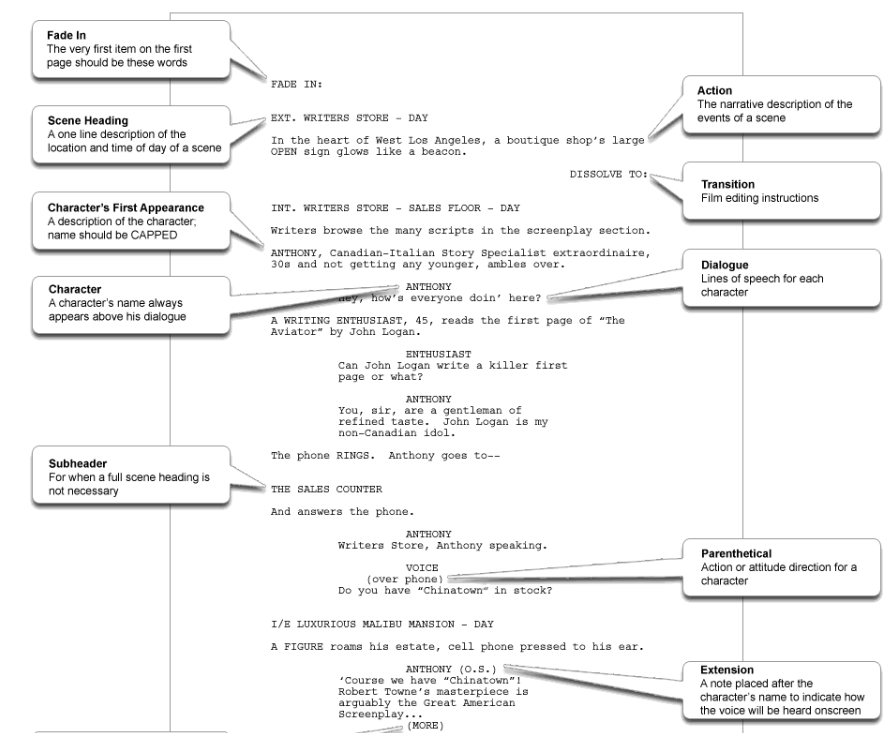
Based off this example, an important characteristic of scripts seems to be its use of sensory details and emotive language to create a distinct vision of the atmosphere and scene. In addition to this, there are a direct statement of events detailing the character’s dialogue and mannerisms. (ie the capitalization of character names followed by their dialogue directly below) This contradicted my initial impression of a script, which I thought consisted of dialogue exclusively. After doing research I also discovered that a formatted script page in Courier font equals roughly one minute of screen time. Based off this estimate, we will try to limit our script to 2, possibly 3, pages maximum.

My group and I have not yet begun the process of writing our script (T^T) , however, I would imagine that based off our discussions regarding the plot it would probably look something like this:

Again, this is just an example of what our script could entail and was made mostly for the purpose of generating practice and understand of the specificalities associated with scriptwriting. It is unlikely that the script will remain this way and of course is subject to change as our ideas shift. It goes without saying, when the official script is written I will be sure to blog about it. 🙂
Sources Cited
 Lucid Elucidations