which production company will we choose? :0

Since our film will be produced under a generally low budget it is important we choose a production company that caters to these requirements accordingly. The production company we choose will have a significant impact on how our audience engages with our film as well as the attention it may or may not receive. Before my group and I can come to a decision, I must evaluate our options.

The first production company my group and I are considering is A24. This company is one which specializes in indie films and have created movies across a wide spectrum. To name a few, Hereditary (2017), Moonlight (2016), and Lady Bird (2017). Budgets for A24 tend to be around 5- 15 M USD. This is a considerably high budget for an independent company.

The second is Blumhouse Studios which is organized and managed by Jason Blum, an Academy Award-nominated and two-time Emmy and Peabody Award-winning producer. This company specializes in “micro budget” horror films and has made numerous hit movies such as Get Out (2017) Halloween (2018) , and The Visit (2015). Blumhouse’s most trademark movie, Paranormal Activity, was created for 15,000 and grossed over 200 million worldwide. Blumhouse has a 10 year deal with Universal Pictures, which, if chosen, would give our film an opportunity to gain more publicity. Since Universal is reputable and known for putting out good movies , people will be more inclined to see our film.

Sources

the significance of sound (c:

Since researching thriller films more in depth, I’ve discovered a commonality in each one tends to be it’s dependence on sound to evoke emotion and build the suspense that will serve as the backbone of the film. It seems that in order to make the film effective, the sound must be equally as powerful as the images on screen.

Of course, Spider-Man is no thriller film, and Peter Parker is no Hannibal Lector, but this video perfectly demonstrates how crucial of a role sound plays in creating emotion. As I’m sure many others can relate, watching this video made me extremely uncomfortable and it didn’t do much asides from strip the clip of music and heighten the cacophony of ambient sounds. Silence, for whatever reason, is incredibly unnerving.

“Beginning at infancy, the constant media soundscape has provided the background noise either side of bassinet, kindergarten, school and university. It is little wonder many of my students feel agitated and ill-at-ease when there is not at least one portal providing background noise. ”

Bruce Fell, Lecturer, School of Communication and Creative Industries, Charles Sturt University

In a study conducted by Bruce Fell a professor at Charles Sturt University, the eeriness of silence was investigated in 580 undergraduate students. It was reported that most students grew up with ambience of TV or radio and thus groomed with background noise throughout their entire life. The study suggests that being accustomed to constant sound makes the absence of it uncomfortable.

“The lack of noise made me uncomfortable, it actually seemed foreboding”, observed one student. Another said “perhaps, because media consistently surrounds us today, we have a fear of peace and quiet”.

Sources Cited: 

music?…some ideas!

After evaluating some title sequences in the horror and thriller genres, I realized that many rely on music, or a soundtrack to progress the events occurring onscreen. Take, for example, the title sequence for The Ring (Verbinski, 2002)

The opening opens immedietley with a lullaby like tune, something used commonly in horror film openings. This choice in music is typically used to juxtapose their conventional purpose of relaxing children. In this case, the tune does the opposite, instead raising the hair on viewers necks and practically screams something menacing is to come. However, the music gradually picks up pace, by the end becoming extremley aggressive and harsh. This is accompanied by the disturbing imagery displayed on the screen.

Though we aren’t too sure whether or not we’d like to include music in our film opening, I felt like it’d be interesting to take a look into some possible ideas!

  1. Haunt Park (Kilgore) by Life After Youth. Not only is this song almost two minutes exactly, it’s incredibly unnerving! The slow melodic pace of the song combined with the distorted voices in the background make for an especially creepy vibe. The abrupt ending contributes to this effect, as well!

2. These Boots Are Made For Walkin’ by Nancy Sinatra. I’ve seen this song used in a few different films before! (Fullmetal Jacket, Oceans 8, Dynasty..etc.) Not only does the old- timey bass line run shivers down my spine, but I felt this song could easily be used to portray the perspective of a villain. (This would challenge a genre convention as well!) It gives me an empowering vibe, one that is almost sinister. I think a horror film from the perspective of the villain would definitely be an interesting approach!

3. Yet another iconic song! Paint it, Black by The Rolling Stones! As with the previous song, I feel this song could work incredibly well at establishing a sinister vibe and creating almost a “theme song” for a villain or antagonist. However, for this song at least, I think an instrumental may work better so as not to distract from the content of our opening.

the purpose of music in film

Since my group and I haven’t yet determined whether or not we’d like to incorporate a song/ score in our film opening, I’ve taken it upon myself to research the purpose of music and the effects it would create.

The first film, created in 1895, was as a silent film, a movie with little to practically no sound whatsoever. It wasn’t until 1927 that the first film with sound emerged, and even then, many filmmakers had not yet adopted this means of technology yet.

That being said, in a world consumed by digital media, many consider music and scores an essential part of a cinematic experience. So what makes it so important?

Effects music can achieve:

  • Reinforces or foreshadows narrative developments
  • Creates a vibe/ atmosphere/ tone
  • Gives meaning to a character’s actions or translates their thoughts; and it creates emotion
  • Add depth to a scene or character
  • Building up tension

Take this scene from Baby Driver (Wright, 2017) for example:

In just the 1 minute and 39 seconds this scene lasts for, many things happen. Just to name a few, Baby and his team arrive at the scene to rob a bank, they escape the bank, a police officer arrives, the police officer is shot, and Bats (a member of their team) dies after Baby floors it into another vehicle. The song, Intermission by Blur, begins slowly until it gradually builds up speed and pace in accordance with the events that occur. This scene would not have been the same without music and that’s for sure. It plays a critical role in building the tension and suspense observed in the scene. From the uncertainty regarding whether the team will be successful in their bank heist to the panic that arises at the first sight of the police officer, this song appears to hit the mark incredibly well.

Sources Cited: 

our intended audience! :)))

Finally deciding on a genre begs the question of this: who will our film be oriented towards? This is an important factor to consider given the success of our film is entirely dependent on our audience, the people who would be investing their time and money into our film. After some extensive research, this is what I discovered 🙂

graph to show the relationship between favorite movie genres and their success at the box office in billions (USD)
the same study as the graph above, except now it has been organized by gender ; dark blue signifies female, light blue signifies male

Given the graphs above, it is obvious that thriller movies tend to perform well at the box office – receiving fifth place overall in film genres and have a very versatile audience range. 83% of the participants who voted their favorite genre as thrillers were female and 84% were male. This correlation shows that regardless of the content, our film will likely appeal to a wide range of people. However, given the mature content and themes consistently prominent throughout thriller movies, our movie will not appeal to younger audiences. Since thrillers sometimes contain imagery of psychological disorders, violence, and death, younger audiences may find it too disturbing.

In order to perform well at the box office, our film must be versatile and appeal to a good range of people. Since 13 -24 is the age group that which cinemas experience the most volume, our movie (if given a rating) would receive that of PG-13. It will contain some sensitive themes, but nothing explicit enough to require an exclusively adult audience. This rating will practically guarantee the success of our film and ensure that we profit off it. Off the same coin, our film will be advertised appropriately in order to effectively represent the nature of the film. Since ages 13-24 are known for being technologically savvy, the film will be advertised across multiple social media platforms such as YouTube, Instagram, and Twitter.

Sources Cited: 

we’ve decided…thriller it is!

After much debate and discussion, my group and I have finally decided to move forward into the direction of the thriller genre. We felt this was most appropriate as the film “Lucid Elucidations” will likely encompass some psychological elements that unnerve the viewer rather than scare them. Moreover, today I will analyze Netflix’s ‘Bird Box’ that was released in December of 2018. This film is categorized as a horror, thriller, and drama, a perfect example to research. 🙂

The scene opens with the imagery of water, more specifically an aerial shot of river rapids. This choice of scenery is something that poses significance later in the film as it is the character’s means of reaching sanctuary. This is revealed using offscreen Malorie describes the journey through the rapids as something that will be extremely difficult, and similarly just as dangerous, easily resulting in death if Boy & Girl take off their blindfold, speak, or don’t follow her directions. Right off the bat, the movie creates a juxtaposition between the typical symbolism of water (life, purity) and the established meaning that the movie produces. (danger, death, and destruction.) Twisting what is typically perceived as normality appears to be a common convention of thriller movies that I’ve noticed, and definitely something I will keep in mind as a possibility for my film.

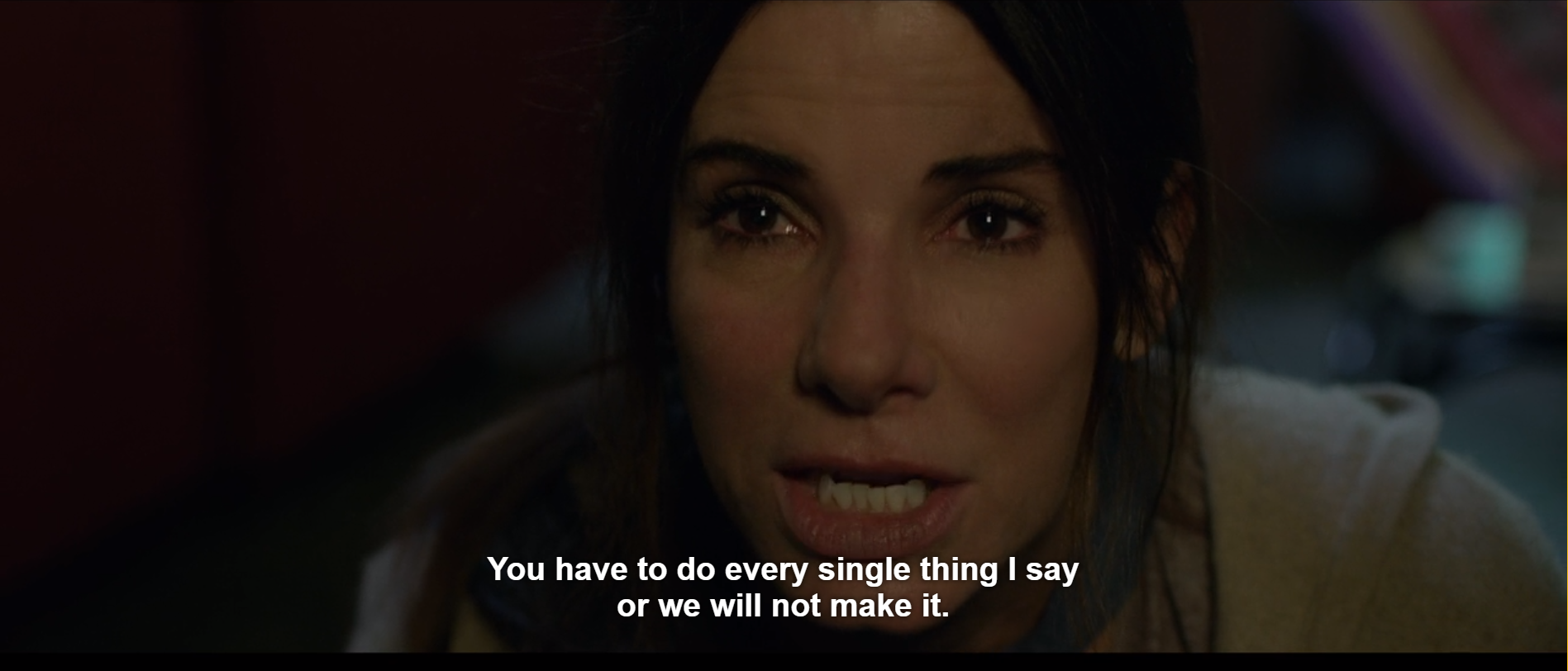
Following the long takes of the rapids, we are then met with close ups and extreme close ups of Malorie urging *quite aggressively* for the kids to follow her instructions, considering their lives depend on it. The scene stalls on Malorie’s face for quite a long time; this is done for the purpose of inducing intimidation from the audience and establishing the intensity of the scene. This inserts the viewers into the action and makes us feel as if we’re being spoken to directly. This also helps to emphasize Malorie’s emotions as makeup has obviously been manipulated to make it appear she’s been crying , or at the very least in distress.

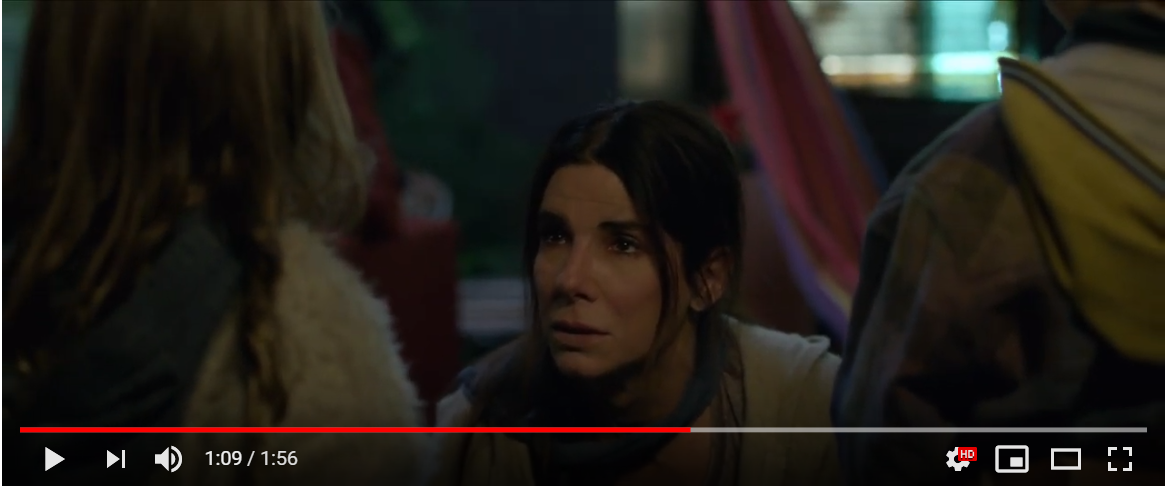
Here we see a three shot of Malorie the kids. Group shots tend to represent strength in unity and this scene is no different. Despite Malorie’s abrasive nature this emphasizes the importance in teamwork and the significance in establishing that they are all on the same page. There is shallow focus implemented in the background and deep focus on the characters which again represents that they are all tuned into the conservation and focused on Malorie’s instructions.

another day, another analysis…

In order to effectively represent my genre, it is absolutely crucial that I have a solid understanding of the film conventions, methods of cinematography, and patterns that add up to make a good horror film. In which case, what better movie to investigate than the horror classic ‘It’ which earned over 700.4 million USD in the box office?

Much of the opening sequence for It contains crosscutting, an editing technique used with the intention to direct the flow of conversation- in this case the conversation occurring between Georgie and Pennywise. Here, a low angle shot is employed to emulate Pennywise’s perspective from the sewer. This is ironic, considering low angle shots typically place the viewer in a place of inferiority and weakness. Obviously, Georgie’s timid and innocent persona does not evoke this kind of emotion.

In contrast to the shot discussed previously, we are now immersed into the event from Georgie’s perspective. This is done through the use of an over the shoulder shot. Much like before, there is a paradox present here in using a high angle shot as it places the subject into a position of inferiority. Clearly, Pennywise is not the victim in this situation.

Like most horror films, close ups are present throughout to aid in producing and demonstrating fear.
In addition to this, lowkey lighting, specifically chiaroscuro lighting is used to manipulate the shadows on Pennywise’s face. This makes him appear scarier and intimidates the audience. (unless of course you’re weird and clowns don’t scare you sMh)

After Pennywise tears Georgie’s left arm off, the balance of the camera angles are suddenly shifted. Unlike before, the viewer has now been removed from the action and instead immersed into an omniscient perspective of the event. We are now observing the scene through a crane shot of Georgie lying helpless on the pavement. The camera begins to shake violently (also known as a canted angle), thus disorienting the viewer and simulating the panic/ distress being experienced by Georgie. Not to mention, Pennywise’s hand barely creeping into the frame makes this all the more disturbing.

conventions of thriller and horror movies :0

My group and I are debating whether we would like to push our film more into the direction of horror or thriller. In today’s post, I will outline some conventions of each genre so I can better determine which one I would like to choose!

Nightmare on Elm Street, Friday the 13th, Scream, Chucky

Horror:

Themes tend to revolve around: 
  • Good vs. Evil
  • Religion/ Supernatural and the Afterlife
  • Nightmares , Madness, Insanity, Suicide
  • Childhood fears and issues
  • Revenge
  • Murder/ Death/ Hatred
  • Darkness, Demons, Satan

Horror movies tend to follow a chronological sequence of events and have lots of foreshadowing sprinkled throughout to create a sense of apprehension and fear. There is typically defined hero and antagonist roles, followed by many characters who are victims of the antagonist. (Usually uses the stereotypes of teenagers, young women, police/ authority figures)

Settings Used: 
  • Hospitals, Insane Asylums,
  • Mental Institutions or Hotels (long hallways and lots of rooms)
  • Graveyard or Cemetery
  • Churches or Convents
  • Isolated communities or remote locations (cabin, abandoned mansion, haunted house, ghost town, farm field, dark woods, tunnels) – deserted places
  • Basements, Attics, Science Labs
Mise En Scene
  • Lowkey lighting
  • Emphasis on shadows
  • Knives, weapons
  • Blood
  • Black/ Red imagery
  • Dark colored clothing
  • Makeup used to create the illusion of wounds/ illness

Thriller

Hush (2016)

Since thrillers are a subgenre of horror, a lot of the genre conventions tend to collide. It is the subtle nuances, however, which sets them apart.

Thriller movies are mostly defined by the emotions they elicit from the viewer, i.e: heightened senses of anticipation, suspense, anxiety, and alertness. While horror movies main purpose is to scare, thrillers usually tend to make us more uneasy.

Some common tropes of a thriller film include: 
  • Flashbacks/ Flashforwards
  • Quick cutting
  • Discontinuity Editing
  • Use of shadows
  • Black/White imagery
  • Music, which is probably the most important as it contributes to the eerie vibes and emphasizes the suspense built between scenes. Tension and release is an important cinematic technique constructed using music.

Sources Cited:

– Thriller-Codes-and-Conventions-provided-by-Cross-Sectoral-Teachers-2017 – https://1drv.ms/p/s!AtW96RnwgcyfhQICNmhUxWjaPpnahttps://www.filmsite.org/thrillerfilms.htmlhttps://prezi.com/_bkrwwzfisyh/codes-and-conventions-of-the-thriller- genre/

why you should never do a horror movie in comic sans

The importance of font and color !

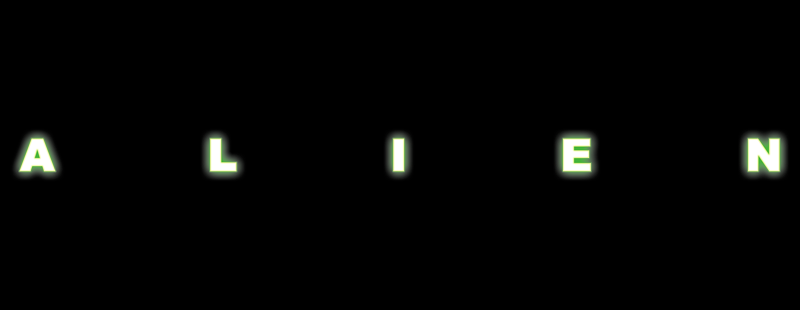
I don’t think I even have to say it but I will: comic sans doesn’t work in any scenario, especially not horror! After creating this abomination I know that now. x( In any case, titling is extremely important for setting the image of a horror movie. In most horror movies, they appear to use large fonts in any variation of deep red, grey, white and black. Sometimes the font appears to emulate handwriting, blood splatters, or typewriters.

Alien (Scott, 1979)
Prom Night (Lynch, 1980)
The Evil Dead (Raimi, 1981)

The Evil Dead (1981) title text utilizes angles and edges to portray the struggle and dichotomy between victim and villain. The font is intense, putting viewers on edge in combination with the disturbing image of a young woman fighting for her life. The letters ‘V’ and ‘A’ are extending much further than any of the others, representing an attempt at escape from the limits of the borders.

Carrie (de Palma, 1971)

Alternatively, the title font for the movie ‘Carrie'(de Palma, 1971) utilizes a more minimal approach. This is in direct contrast with the powerful imagery displayed in the photo. A young girl covered in blood standing in the midst of flames. This picture induces fear and makes audiences wonder what the girl is capable of.

Overall, title fonts are essential to a viewer for various reasons.

Typography can:

  • Interact with metaphorical imagery or symbols in a film
  • Establish the tone (For instance, a title with blood splatters would indicate that the movie contains death, gore, blood, imply that the genre is ‘horror’)
  • Make an impression on the viewer
  • Tie into branding; (E.g The font in “Harry Potter” is extremely distinguishable)

Sources Cited:

it follows…but what is “it”?

For today’s post, I’ve decided to do an analysis of the opening sequence from It Follows, a film directed by David Mitchell (2014) . I’ve chosen this excerpt as the movie encompasses a variety of genres: horror, mystery, and thriller. Not only that, but it appears to contain the many aspects of horror/ thriller films that I intend to implement into my title sequence. 🙂

First and foremost, I noticed that the opening doesn’t leave much room for discovery. The sequence reveals practically nothing, while also managing to keep the viewing audience on their toes, enthralling them into this terrifying but purposely ambiguous storyline. This is something I’d like to incorporate into my film to prevent it from being too trailer-esque while also maintaining a strong sense of mystery that interests my viewers.

The cinematography is not very extensive in this scene, in fact, it’s actually quite limited as it is done almost entirely using wide shots, push in/outs and tracking shots. However, this seems to work to it’s advantage, as it appears to isolate the protagonist (who is later revealed to be named Annie) and sets the tone of apprehension as we expect the off-screen threat to draw closer to her. This fear of the unknown is a reoccurring theme that shows to be especially effective not only here, but throughout the entire course of the film as well. In addition to this, the title sequence uses ambient sound and heightened diagetic sounds to further emphasize the foreboding and menacing vibe of the film. In parts, the sound, or lack therof, makes the audience anxious and engages a stronger sense of suspense and eeriness.

Moreover, mise-en-scene plays a huge role in assisting to create the vibe of the film. For one, a dark and dull color pallette is used, accompanied by low key lighting to induce uneasiness. The costuming , high heels and undergarments, put the protagonist into a position of vulnerability and immediately establishes her as the victim in this narrative. This touch may also be used to illustrate how women are often represented in horror films: weak, unprepared, and most commonly, as the victim. Given this films success of $14,674,076 of domestic total gross, by investigating the conventions that made it effective, I can hopefully apply this knowledge to create a similar effect! 🙂

Sources: